Does “Natural” Mean Safe? Does “Artificial” Mean Dangerous?

People often use the word natural when they want to say that something is good.

Natural food. Natural medicine. Natural ingredients.

Artificial is often used to mean the opposite.

Artificial chemicals. Artificial flavors. Artificial organisms.

The assumption is simple:

Natural things are safe. Artificial things are dangerous.

But is this true?

Nature Is Trying to Kill You

That might sound dramatic, but nature produces many dangerous things.

Poison ivy is natural.

Venom from a rattlesnake is natural.

Deadly mushrooms are natural.

Bacteria that cause disease are natural.

A hurricane is natural.

Cancer is also natural. Cancer occurs when cells in an organism begin growing and dividing in ways that harm the organism. Nothing artificial has to be added for cancer to develop.

Natural selection does not make organisms safe for humans. It helps organisms survive and reproduce.

A poisonous plant might produce a toxin because the toxin prevents an animal from eating it. This is good for the plant. It is not good for the animal.

Nature is not good or evil. Nature is a system.

Artificial Things Can Also Be Dangerous

This does not mean that artificial things are automatically safe.

Humans can create dangerous chemicals, weapons, pollutants, and technologies.

An artificial compound might remain in the environment for a long time. A machine might injure someone. A new medicine might have side effects that were not discovered during testing.

Artificial things can create risks that would not have existed naturally.

The problem is not that artificial things are always dangerous. The problem is that humans can make mistakes.

Sometimes we do not understand the full effects of what we create. Sometimes a product solves one problem while creating another.

A pesticide might protect a crop but harm beneficial insects.

A medicine might cure a disease but produce serious side effects.

A plastic container might preserve food but create pollution after it is thrown away.

The technology might be good at doing its job while still causing problems somewhere else.

What Does Natural Mean?

The definition of natural can be confusing.

Humans are part of nature. Humans build things using materials found in nature. Does that make everything humans create natural?

A bird builds a nest.

A beaver builds a dam.

A human builds a house.

At what point does building become artificial?

Consider some questions:

Is a selectively bred dog natural?

Is corn that has been bred by humans for hundreds of years natural?

Is a plant produced through hybrid breeding natural?

Is a plant changed by exposing its seeds to radiation natural?

Is insulin produced by genetically modified bacteria natural?

Is a vitamin made in a factory different from the same vitamin found in an orange?

There is a gradient between natural and artificial. There is not always a clear line.

Corn is a good example. Humans have changed corn through generations of selection and breeding. Modern corn looks very different from its wild ancestors. The breeding process did not require modern genetic engineering, but the plant was still changed by people.

Calling the corn natural does not tell us how much humans changed it.

Chemicals Are Not Automatically Bad

The word chemical also scares people.

Everything is made of chemicals.

Water is a chemical.

Oxygen is a chemical.

Sugar is a chemical.

The toxins produced by plants are chemicals.

The compounds in medicine are chemicals.

A chemical is not safe or dangerous because it has a complicated name. Its effects depend on the compound, the amount, how someone is exposed to it, and how long the exposure lasts.

Water is necessary for life, but too much water can kill a person.

Salt is needed by the body, but too much salt can cause health problems.

A dangerous compound might be harmless at a very low dose. A useful compound might be dangerous at a very high dose.

The question should not be, “Is this a chemical?”

The question should be, “What does this chemical do?”

Natural and Artificial Versions

Sometimes an artificial product is created to copy something found in nature.

Insulin is naturally produced by the human body. People with diabetes may not produce enough insulin or may not use it properly.

Scientists can genetically modify microorganisms so that they produce human insulin. The insulin is then collected and used as medicine.

The production system involves biotechnology. The final insulin performs the same biological job as insulin produced inside the body.

Is the insulin natural or artificial?

It is produced through an artificial process, but it copies a natural human protein.

The more useful questions are:

Does it work?

Is it safe?

How pure is it?

What are its side effects?

Can people afford it?

Calling it natural or artificial does not answer any of these questions.

Natural Products Can Be Safer

There are cases where a natural product may be safer or better.

A natural material might break down more easily in the environment. A crop that naturally resists a disease might require fewer pesticides. A food with fewer processing steps might contain fewer unnecessary additives.

Traditional practices can also contain knowledge developed over many generations.

However, being traditional does not prove that something is safe. People used dangerous medicines and agricultural practices for hundreds of years before understanding their effects.

History gives us information, but it does not remove the need to examine evidence.

Artificial Products Can Be Safer

Artificial products can sometimes be designed to remove a natural danger.

Pasteurization uses heat to kill harmful microorganisms in food.

Water-treatment systems remove pathogens and pollutants.

Synthetic medicines can provide controlled doses that are more predictable than the amount found in a plant.

A naturally occurring compound might be mixed with hundreds of other compounds inside an organism. Producing the useful compound separately can make the dose more consistent.

Artificial does not necessarily mean that something is less safe. It may mean that people have attempted to control how it is produced and used.

Of course, attempting to control something does not mean that the control will always work.

That is why testing and monitoring are important.

Look at the Whole System

Instead of asking whether something is natural or artificial, we can rate it using three categories:

Good for People: Does it improve human health and avoid harming people?

Good for Planet: Does it protect biodiversity, habitat, and the ability of living systems to continue?

Good for Profit: Does it solve a useful problem and create value?

We also have to examine the technology at different scales.

A natural pesticide might be safe for a person eating a small amount of food but harmful to workers exposed to concentrated doses.

An artificial fertilizer might increase the amount of food produced but create pollution when it enters rivers.

A synthetic medicine might save lives but be too expensive for most people to use.

A technology can be good in one category and bad in another.

Known Knowns and Unknown Unknowns

New technologies create another problem.

We know some of their effects. There are also effects we have not discovered.

This is especially important when something is released into the environment. A medicine can sometimes be stopped if problems appear. An organism that reproduces may be more difficult to remove.

But natural products also have unknowns.

A plant-based supplement might contain compounds that have not been carefully studied. The amount of each compound may change depending on where the plant grew, when it was harvested, and how it was processed.

Something does not become predictable simply because it came from nature.

Both natural and artificial products can contain known benefits, known risks, and unknown risks.

Closing Thoughts

Natural does not mean safe.

Artificial does not mean dangerous.

These words describe where something came from or how it was made. They do not tell us what it does.

A poisonous mushroom does not become safe because it grew naturally.

A medicine does not become dangerous because it was produced in a laboratory.

We should judge products and technologies by their effects.

Are they good for people?

Are they good for the planet?

Do they create useful value?

What happens after one year?

What happens after twenty years?

Who receives the benefits?

Who carries the risks?

The world is more complicated than natural good and artificial bad.

That makes decisions harder, but it also makes them better.

Did you learn something? Did we get something wrong? Leave a comment below.

Is Hybrid Corn good?


If you haven’t already, read about Mendel and Basic Genetics. Here we will talk more about hybrids and how they are important and controversial in modern agriculture. If you don’t think you’ll want to read about corn, that’s ok most of this isn’t about corn, but corn is a key player later on.

So Hybrids, the definition can be confusing because there are eight different types of hybrids. We’ll talk about three of the most common types:

1. Species Hybridization – Crossing two different species. (ex: Lion and a Tiger) This gives rise to an organism that has two different types of chromosomes and they might not match up. If the chromosomes don’t match then this hybrid can’t reproduce (think about a Mule.) In plants, hybrid speciation (a new species) can occur when this mismatching of the chromosomes produces a infertile organism. However, plants have a trick that they can pull off that animals normally don’t do, plants can double their chromosomes. By doubling their chromosomes, this means that they have two copies from each parent not one and when they go to produce a gamete (sperm or egg) the chromosomes can be divided and a new species is created.

2. Sub-Species Hybridization  – This is when two individual organisms can biologically reproduce, but are found in different areas or look significantly different. An example is a Siberian Tiger and a Bengal tiger (Indian Tiger.)

3. Population Hybridization – The organisms are the same species, could be from the same area, and might even look the same, but are from two populations. This is where the corn comes in. (ex: a flower in the valley and a flower on top of a mountain could be two different populations)

Corn has been bred for hundreds of years for the benefit of humans. It is so specialized that the corn that we eat wouldn’t survive without humans. So, lets say a breeder wants a corn that is disease resistant to leaf blight. Another breeder cultivates a variety that tastes sweeter. These two breeders happen to work for the same institution and during a holiday party they decide to make a cool corn variety that is disease resistant and sweet. So they cross the two purebred lines and get a hybrid. That hybrid generation will have the best traits from both parents. It will be sweet and be disease resistant.

Great! We just made SUPER-Corn. Not quite, when the hybrids cross with other hybrids the next generation will not be as good. The traits will be distributed similar to a bell curve. In fact, each generation after the hybrid cross will have traits that would be seen in a normal population, or what you started with. A corn variety that isn’t particularly sweet and not very good against leaf blight. Great job you just undid all of your work and got fired!

A way to avoid the lose of good traits, also called hybrid vigor is to always have hybrids. If a farmer always plants and uses the first cross of the two corn types (Sweet and Disease Resistant) then they’ll have the best corn. The problem is that you would have to maintain the purebred lines. Have corn that is just really sweet and just have disease resistants. Farmers can’t do this, because they don’t have access to seeds of the purebred lines. Instead farmers pay seed companies for the seeds of the hybrid corn. You could ask why does it matter?

An advantage is that better corn is being produced and might be feeding more people. The disadvantage is that farmers have to pay more for their seeds and have to pay every year, instead of using seed from the previous year’s crop. Not everyone can pay. Farmers in countries that need more food aren’t able to pay the seed companies and end up taking loans they can’t pay back.

There are many types of hybrids, one type: Population Hybridization is able to produce superior offspring. Humans use this ability to better grow food. The problem is the price we pay for better corn.

If you learned something please share.

Bt Toxin and Cry1Ac

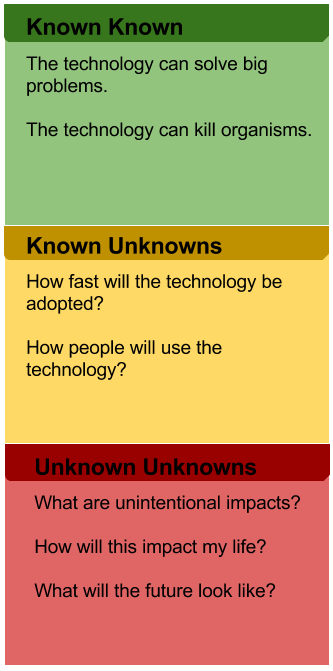
Bacillus thuringiensis is a bacteria that can produce a toxin. A gene for this toxin is Cry1Ac. The Bt or Cry1Ac toxin kills insects by cutting up their digestive system. Cry1Ac toxin  does not have effects on non-insects.  We’ll use this table to rate the GMO.

Monsanto first inserted the Cry1Ac gene into cotton (Monsanto, 2002). The Bt Cotton has reduced the use of pesticides. Because of the need for fewer pesticides, fewer farmers report pesticide poisoning. Farmers spend less money on pesticides. Consumers don’t see any price difference. (Pray, Ma, Huang, and Qiao, 2001)

Bt Cotton has also shown to increase yields for farmers in poorer countries (Thirtle, Beyers, Ismael, and Piesse, 2003)

Let’s look at the current rating. 0 for the direct effect on humans. +1 for indirect effects on human health.+1 on profit for local producers. 0 for the profit of consumers. -1 on planet biodiversity. The only measurement left is planet habitat. To see this we need to look at the long term effects.

Why look long term? There is a common question for GMOs and biotechnology. What are the long-term effects? Just looking at one year a system might work, but over several years a system might fail. With just one years worth of data you would conclude an opposite result than a multi-year study.

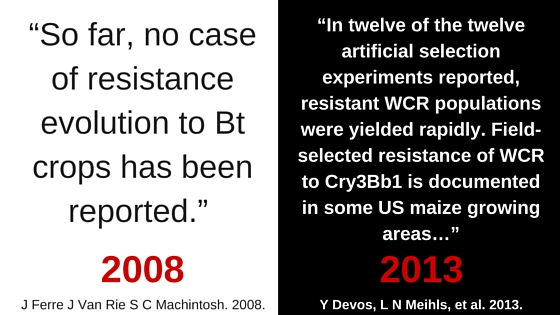
Compair Bt Toxin 2008 and 2013

One long term effect is resistance of insects to Bt toxin. Insects eat the plant. The plant produces Bt toxin. The insect eats the Bt toxin. The insect dies. This systems might work however life always finds a way. The insects become resistant to the toxin.

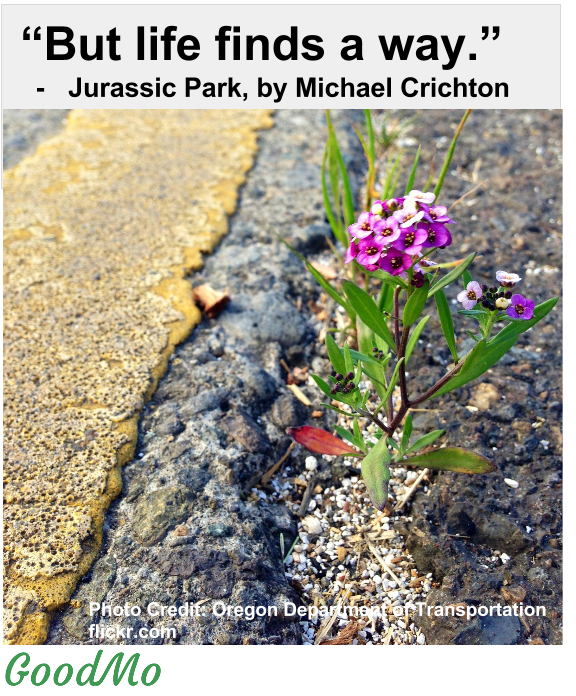
Life Finds a way. Jurassic Park, by Michael Crichton

There are two reasons why insects develop resistance to the Bt toxin. One reason is that it is only one compound. If there were many compounds all affecting different parts of the insect it would take longer for the insect to adapt to all of the compounds. The second reason is that the compound kills the insect. Death is the strongest selective pressure in evolution. If an organism dies before mating then all genetic information is gone. If the GMO instead had a compound that disabled the insect instead of killing it would take longer for the insect to adapt.

Compounds that disable but not kill the pest are found in nature. These compounds could be used instead of Bt toxin to prevent insects from becoming resistant.

The first generation of Bt toxin plants produce the toxin throughout the plant, possibly effecting beneficial insects like pollinators. This is reducing the habitat available for insects. Overall this GMO would get a score of 0.  Good at reducing run-off and preventing insect damage, bad a increasing biodiversity and habitat.

Did you learn something? Did we get something wrong? Leave a comment below.

Work Cited:

Monsanto. 2002. Safety Assessment of Bollgard Cotton Event 531. http://www.monsanto.com/products/documents/safety-summaries/bollgard_pss.pdf

Pray, C., Ma, D., Huang, J., & Qiao, F. (2001). Impact of Bt cotton in China.World development, 29(5), 813-825.

Thirtle, C., Beyers, L., Ismael, Y., & Piesse, J. (2003). Can GM-technologies help the poor? The impact of Bt cotton in Makhathini Flats, KwaZulu-Natal.World development, 31(4), 717-732.

Ferre, J.,  Van Rie, J., Machintosh, S. C., (2008). Insecticidal Genetically Modified Crops and Insect Resistance Management (IRM). Progress in Biological Control. 5,  41-85

Devos,  Y., Meihls,  L. N., et al. (2013). Resistance evolution to the first generation of genetically modified Diabrotica-active Bt-maize events by western corn rootworm: management and monitoring considerations. Transgenic Research. 22(2),  269-299

Process for Making TransChromo Organisms

There are currently three main ways to insert genetic information into a higher plant: CRISPR-Cas9, using Agrobacterium tumefaciens, and a Gene Gun.

We will focus on the Gene Gun for this article. The problem with a Gene Gun is the expression. Randomly inserting a gene into an organism causes the expression to decline after time even after screening and selection.

We have gotten better at using the Gene Gun by also incorporating regulatory genes with the gene of interest, however, the placement of that gene is uncontrolled and would effect expression.

What is the solution? Insert a whole chromosome. Let’s say you want to insert a defense protein from Ampelocera hottlei into Ulmus americana, American Elm as a solution for Disease.

After DNA extraction restriction enzyme would be used to cut the DNA selectively. A marker would be used to identify the target gene. Electrophoresis would then separate the large piece of DNA with the target gene. This piece would then go through PCR amplification. The DNA then would be coated onto a gold particle and shot into the target organism, American Elm.

Assuming that the gene gun insertion process would allow this large piece of DNA the benefits of doing this would be that most regulatory genes would also go with the target gene and expression would be preserved. In addition, other genes may carry other unknown benefits to the target organism.

How to rate a GMO

If we gave a GMO a score what would it be? How would we rate a GMO or any technology? We rate based on the three criteria:

Good for People: Improving the physiological health of humans, and is not detrimental to their health.

Good for Planet: Increases the biological diversity and biomass potential (more things can live)

Good for Profit: Is useful, creates value by addressing a need.

You can’t have one measurement for each  category. At least two things need to be measured. These measurements have to focus on both large and small scales. An example of why one measurement would be bad is when a compound causes pollution but cures a disease. While solving the small problem, curing disease, it creates a larger problem of pollution. Pollution would then cause problems to anyone around.

Rating GMO

Super Good is a score of 6.

Good is a score of 4 to 6 with no negative values.

Little Good is a score of 2 to 4 with no negative values.

Ok is a score of 0 to 2 with no negative values.

Little Bad is a Positive score with negative values.

Bad is a score of -1 to -5

Evil is a score of -6.

Pro GMO vs. Non-GMO what are both thinking?

GMOs are a product of modern technology that has created many to fear the technology. Some people have called for a ban of the technology. While others praising the technology and claim that it will solve many of the world’s problems. This reaction of pessimism and optimism is common with any advancement in technology. This post isn’t about showing how one side is correct and the other wrong, but instead, how each thinks and justifies their position. To examine both sides let’s look at the known knowns.

In 2002 Donald Rumsfeld famously said, “…because as we know, there are known knowns; there are things we know we know. We also know there are known unknowns; that is to say, we know there are some things we do not know. But there are also unknown unknowns – the ones we don’t know we don’t know. And if one looks throughout the history of our country and other free countries, it is the latter category that tend(s) to be the difficult ones.”

He was talking about Iraq and the possibility of the government to give weapons of mass destruction to terrorist groups. Weapons are a technology and have the same problem of pessimism and optimism.

A table showing possible good and bad of technology

The difference between optimist and pessimist is what they value and what carries weight in their thinking.

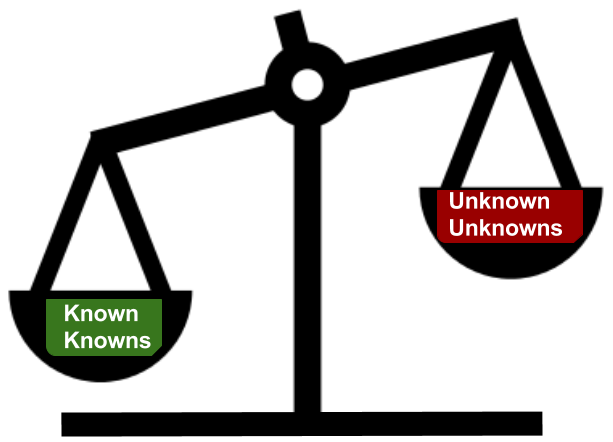
Scale Known Knowns Unknown

For the optimist, they weigh the Known Knows and the current problems more than the Unknown Unknowns. Biotechnology and the ability to create GMOs can; feed more people, reduce the effects of climate change, lift people out of poverty, cure disease. It is the Known current problems that drive the optimist’s thinking.

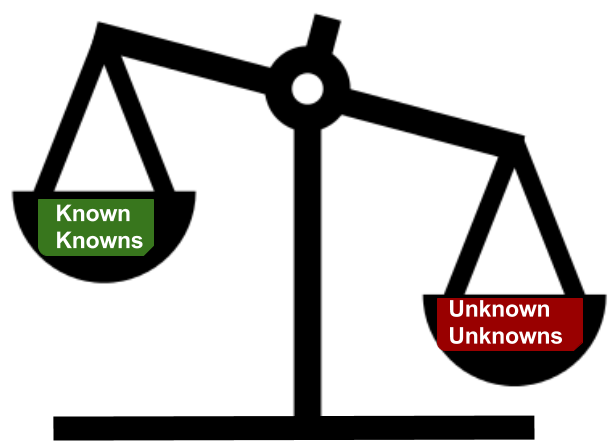
Scale Red down Known Knowns Unknown

The Pessimist weigh the Unknown Unknowns more than the Known Knowns. The pessimist might acknowledge the current problems and that GMOs could provide solutions to those problems. They would then point out and say that we can not take the risk of solving the world’s problems with GMOs because we do not fully understand all of the impacts. They could say that we would make bigger problems by using GMOs.

Closing thoughts:
To move forward, both sides have to acknowledge the concerns and way of thinking of the other. The optimist can work on learning more about the unknowns to remove concerns. The pessimist can learn more about the knowns and how the knows can answer unknowns.

If you look at the three color information stop light you will notice that these statements and questions could be applied to any technology. We have just learned and experience some technologies longer and have removed the unknown unknowns.


What is a GMO?

Genetically Modified Organism or GMO are living things that have been genetically altered using biotechnology. The exact point at which something becomes a GMO with this definition is a little tricky in part because it relies on the use of technology. What you define as biotechnology can significantly impact what is considered a GMO. Some thought questions:

  1. Is breeding a biotechnology and offspring of breeding a GMO?
  2. Is selection of offspring or sperm and egg based upon genetic screening that shows you the offsprings traits produce a GMO?
  3. Is mutating a organism by exposing it to radiation then genetic screening to see any new traits acquired from the radiation a GMO?
  4. Does DNA methylation, (when adding CH4, one carbon and 4 hydrogen to DNA can inhibit a gene from being expressed) produce a GMO?
  5. Is adding an additional copy of a gene to inhibit a trait (iRNA, a form of knockout) produce a GMO?
  6. Is taking out a gene (CRISPR) produce a GMO?
  7. Is inserting a gene from another organism produce a GMO?
GMO
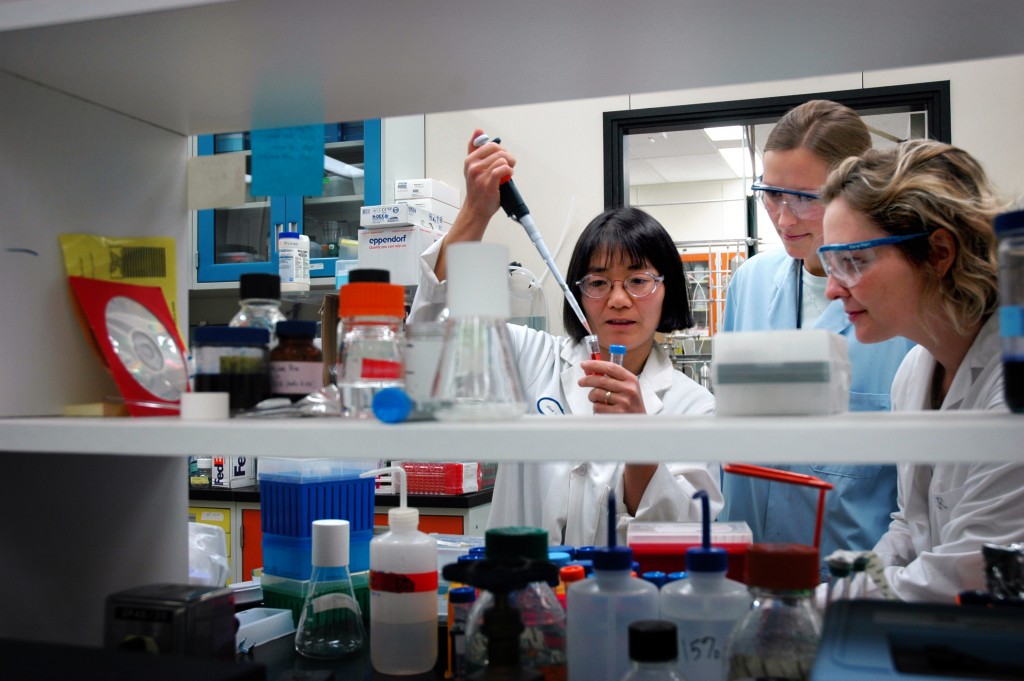
Photo from: Idaho National Laboratory (flickr.com)

As you can see there is a gradient to what we might consider to be a GMO. The point of this is not to confuse you into thinking a GMO is what it isn’t, but to understand it better. If you are dying to find out the answer; most countries and people would say a GMO would be everything after 3 or 4.

Biotechnology Heals then Burns Business Models

Many companies have started focusing on biotechnology and incorporating it into their business model. After Genentech emerged with the first compound produced from bacteria (insulin) pharmaceutical companies started partnering with biotech companies. You could call this the first wave of biotech adoption. The reason for this was that the return on resources spend to develop new drugs was declining. Pharmaceutical companies are spending more to develop less drugs. There are many reasons for this including: easy drug targets already developed, drugs have to be more profitable than the cost of going through approval, and drug companies want drugs that everyone can take (Blockbuster drugs). Pharmaceutical companies couldn’t develop drugs that would make a lot of money while still using the same technology, so in the 1990’s they turned to biotechnology companies to help them make drugs. This healed the business model of the pharmaceutical companies, however now it is threatening their existence like never before.

19078093660_e257942c9f_h
Photo from: NTNU, Faculty of Natural Sciences and Technology (flickr.com)

Before the existence of biotechnology companies (companies that focus on new technology), pharmaceutical companies only competed against themselves to make drugs. When Genentech created a drug without being a pharmaceutical company. It licensed it’s ability to create insulin to other companies so Genentech didn’t need to have the capacity to produce it. Biotech companies can now compete with pharmaceutical companies, then why are pharmaceutical companies still around? They will probably turn into what record and network television companies are today. These companies are still around because they have three things: access to an audience, networks, and resources. Record companies have relationships with radio stations and can encourage them to listen to and play a song. Television companies can have millions of people watching a new show. Both can gather resources such as writers, producers, and talent to make new products. And both have more resources than a kid with a youtube channel; recording studios, sets, props, and cash. Pharmaceutical companies will probably change their business model to be more like this.

Just like record and television companies, pharmaceutical companies have all three things: access to audience, network, and resources. Pharmaceutical companies have relationships with doctors that biotech companies do not have. They can introduce drugs to these doctors and so that them prescribe them to patients. They are fluent in navigating the governmental regulation and have cash on hand. Currently pharmaceutical companies are buying biotech companies when they discover a promising drug or drug target, but as pharmaceutical companies become more averse they will want to buy part or all of the licensing rights from these companies. This will push the risk onto the biotech companies and require them to adapt and implement new technology just like they always have.

Be Good